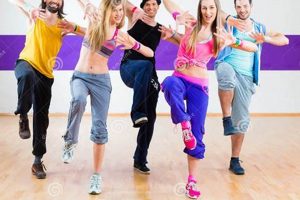
This activity combines the energetic dance fitness program with an element of playful stillness. Participants engage in typical routines involving a variety of music and movement styles. At unpredictable intervals, the music stops, signaling participants to immediately halt all motion and hold their pose until the music resumes. This blend of cardiovascular exercise and momentary isometric holds presents a unique fitness experience.
The integration of sudden pauses enhances coordination, balance, and mental agility, as participants must quickly react to the changing cues. Beyond the physical benefits, the activity fosters a sense of community and lightheartedness, making it an accessible and enjoyable form of exercise for various age groups and fitness levels. It also introduces an element of surprise and challenge to a traditional workout, increasing participant engagement and motivation.
The following sections will delve into the specific movement patterns involved, the potential modifications for different abilities, and the recommended safety precautions to ensure a positive and effective experience for all involved.
Guidance for Optimizing Zumba Freeze Dance Sessions
The subsequent recommendations aim to maximize the effectiveness and safety of sessions, ensuring participants derive the greatest benefit from this dynamic form of exercise.
Tip 1: Music Variation: Incorporate a diverse range of musical genres and tempos. This prevents monotony and challenges participants to adapt to different rhythms, enhancing their coordination and responsiveness.
Tip 2: Gradual Freeze Introduction: Begin with longer freeze intervals and progressively decrease the duration. This allows participants to acclimate to the sudden stops and improve their ability to maintain static poses.
Tip 3: Safe Freeze Poses: Instruct participants to avoid overly strenuous or precarious poses during the freeze segments. Prioritize stable stances that minimize the risk of falls or injuries.
Tip 4: Adequate Warm-Up: Ensure a thorough warm-up routine prior to commencing the activity. This prepares the muscles and joints for the demands of both the dance movements and the static holds.
Tip 5: Clear Freeze Signals: Establish a consistent and easily recognizable signal for the freeze, such as an audible cue or a visual gesture. This minimizes confusion and ensures a synchronized response from all participants.
Tip 6: Modifications for All Levels: Provide modifications for individuals with varying fitness levels or physical limitations. This may include offering seated variations or allowing for gentler movements during the active portions.
Tip 7: Hydration and Breaks: Encourage participants to stay adequately hydrated and incorporate short breaks throughout the session. This prevents fatigue and maintains optimal performance levels.
Adhering to these recommendations contributes to a more engaging, safer, and ultimately more rewarding experience. Participants will not only improve their cardiovascular fitness and coordination but also enhance their balance and mental focus.
The final section of this article will address potential safety considerations and provide guidelines for instructors to effectively manage and mitigate risks associated with the activity.
1. Sudden Stops

Sudden stops constitute a defining characteristic of this activity and directly influence its physiological and cognitive impact. The abrupt cessation of movement disrupts the established momentum, requiring participants to immediately engage stabilizing muscles to maintain balance and prevent falls. The element of surprise inherent in the timing of these pauses necessitates a heightened state of awareness and rapid neuromuscular response. The effectiveness of the method is predicated on the unexpected nature of the stops. If participants anticipate the pause, the training effect is diminished.
Consider a scenario where individuals are actively engaged in a fast-paced Latin-inspired dance sequence. Upon the instructor’s cue, the music abruptly ceases, and the participants are required to instantaneously freeze in their current position. This transition demands the rapid recruitment of core muscles, lower extremity stabilizers, and postural control mechanisms. Over repeated exposure, this process enhances proprioception, improves reaction time, and strengthens the muscles responsible for maintaining equilibrium. The “Sudden Stops” serve not only as a disruptive element but also as a catalyst for developing adaptability and functional strength.
The strategic incorporation of “Sudden Stops” within the activity introduces an element of unpredictability that significantly contributes to the overall benefits. Challenges exist in ensuring participant safety during these transitions, which necessitates clear instruction and modifications to accommodate varying fitness levels. The understanding of the crucial role of “Sudden Stops” allows instructors to optimize routines for maximum benefit and safety, aligning with broader fitness goals of improving balance, coordination, and reactive strength. This integration transforms a typical dance workout into a dynamic exercise that challenges both physical and cognitive abilities.
2. Balance Control
Balance control is an indispensable element within dance fitness routines, particularly where movements are dynamic and rapidly changing. This element is critically emphasized when implementing routines which require intermittent static poses. The activity places exceptional demands on an individual’s capacity to maintain equilibrium, transitioning abruptly between movement and stillness. Therefore, understanding and cultivating balance control is essential for both the efficacy and safety.
- Postural Stability
Postural stability refers to the ability to maintain an upright stance against gravity and external forces. It is the foundational aspect of balance control. A stable posture reduces the risk of falls and injuries. In dance fitness routines, rapid transitions necessitate constant postural adjustments. Without adequate stability, participants are at increased risk of losing balance during freeze segments. Training postural stability improves a person’s base support which is crucial in the exercise.
- Proprioceptive Awareness
Proprioceptive awareness involves sensing the body’s position and movement in space. It is a critical component of balance control, allowing for automatic adjustments to maintain equilibrium. Enhanced awareness enables individuals to react more effectively to changes in momentum. This translates into better performance in the dance fitness routine. The exercise will help hone this awareness, reducing the likelihood of instability and injury.
- Core Engagement
The core muscles, including the abdominals, obliques, and lower back muscles, play a central role in balance control by stabilizing the spine and pelvis. Strong core engagement provides a solid foundation for movement and reduces the risk of injury. Insufficient core strength can lead to instability and compensatory movements, compromising balance. Training to specifically engage these muscles will enhance the ability to maintain a steady posture when suddenly pausing.
- Vestibular System Function
The vestibular system, located in the inner ear, detects head movements and contributes to balance control by providing information about spatial orientation. Proper function of this system is vital for maintaining equilibrium during dynamic movements. Dysfunction of the vestibular system can lead to dizziness, vertigo, and imbalance. Routines that incorporate varied head movements challenge the vestibular system, improving its ability to contribute to overall balance.
These interconnected facets underscore the multifaceted nature of balance control, particularly within the context of dance fitness. By addressing each aspect through targeted training and mindful practice, participants can significantly enhance their stability, coordination, and overall safety. Consequently, the benefits of the exercise can be fully realized, and the risk of injury minimized. Attention to balance is crucial for both participation and positive fitness outcomes.
3. Coordination Demands
The inherent nature of dance fitness, amplified by intermittent static poses, necessitates a high degree of coordination. The integration of diverse movements and the unexpected pauses challenge the neural pathways responsible for sequencing actions, maintaining rhythm, and reacting to cues. This activity, therefore, places significant coordination demands on participants, impacting both their physical performance and cognitive engagement.
- Musculoskeletal Synchronization
Musculoskeletal synchronization involves the coordinated activation of multiple muscle groups to execute a desired movement. In dance fitness, this translates to seamlessly transitioning between steps and maintaining proper form. However, when incorporating the freeze element, this synchronization must occur instantaneously. For example, a participant executing a grapevine step must abruptly halt and maintain their pose, requiring precise control of agonist and antagonist muscle groups to prevent imbalance or injury. Failure to synchronize effectively can lead to compromised form, reduced effectiveness of the exercise, and increased risk of strain.
- Spatial Awareness and Body Positioning
Spatial awareness refers to the ability to understand one’s body position in relation to the surrounding environment. This awareness is critical for navigating the dance space and avoiding collisions with other participants. The freeze component intensifies the demands on spatial awareness as individuals must hold their positions without the aid of visual feedback from ongoing movement. An example of this is freezing in a lunge position near other participants, requiring precise spatial judgment to maintain a safe distance. Deficiencies in spatial awareness can lead to accidental contact, disrupting the flow of the class and posing safety hazards.
- Timing and Rhythm Maintenance
Maintaining timing and rhythm is fundamental to all forms of dance, including dance fitness. Participants must accurately interpret and respond to the tempo and rhythmic patterns of the music. The addition of unpredictable pauses introduces an additional layer of complexity, requiring individuals to anticipate and react to sudden changes in the musical cues. Consider a complex choreography sequence interrupted by a freeze; participants must maintain their sense of rhythm even while holding a static pose to seamlessly resume the dance when the music restarts. Poor timing and rhythm can lead to disengagement, frustration, and a diminished sense of accomplishment.
The aforementioned facets underscore the multifaceted nature of coordination demands within the activity. The convergence of musculoskeletal synchronization, spatial awareness, and rhythm maintenance create a dynamic and challenging environment that enhances both physical and cognitive function. Ultimately, successful execution depends on a participant’s ability to integrate these facets into a cohesive performance.
4. Rhythmic Variety
The integration of diverse rhythmic patterns constitutes a critical element in the design and execution of routines. This diversity serves to enhance participant engagement, improve adaptability, and maximize the physical and cognitive benefits. The purposeful selection and arrangement of music genres, tempos, and rhythmic complexities directly impact the activity’s overall effectiveness. The absence of such variety can lead to participant disinterest and a plateau in skill development.
A Zumba Freeze Dance session that solely employs a consistent, repetitive rhythm limits the range of movements participants can explore and master. For instance, if a session primarily focuses on fast-paced Latin rhythms, participants may struggle when confronted with the slower, more deliberate movements associated with other dance styles. By incorporating a spectrum of rhythms, such as merengue, salsa, hip-hop, and cumbia, participants are challenged to adapt their movement patterns, coordination, and balance in response to the changing musical cues. This adaptability becomes particularly crucial during the freeze segments, where participants must instantaneously maintain their posture regardless of the preceding rhythmic pattern. For example, freezing during a fast-paced hip-hop routine demands a different set of stabilizing muscles compared to freezing during a slow, controlled salsa sequence. The rhythmic variance, therefore, serves to condition a more comprehensive range of physical capabilities.
In conclusion, rhythmic variety is not merely an aesthetic consideration; it is a fundamental component that shapes the overall effectiveness and appeal. Instructors should prioritize the strategic selection of musical genres and tempos to ensure a challenging, engaging, and balanced experience for participants. This necessitates a deliberate departure from repetitive patterns and an embrace of rhythmic diversity to fully realize the potential of this exercise format. By consciously integrating a wide array of rhythmic styles, instructors can promote enhanced physical conditioning, cognitive agility, and overall enjoyment.
5. Unexpected Pauses

The element of unpredictability is central to the framework of activity. The infusion of unannounced interruptions into the dynamic movements significantly alters the physiological and cognitive demands placed upon participants, thereby enhancing the exercise’s potential benefits.
- Neuromuscular Adaptation
The abrupt introduction of pauses compels the neuromuscular system to adapt rapidly, enhancing reaction time and improving the capacity to maintain balance. Muscles must engage quickly to stabilize the body in a static pose, regardless of the preceding movement’s momentum. For example, while transitioning from a high-energy jump to a stationary squat, the quadriceps, hamstrings, and core musculature must instantaneously generate sufficient force to prevent collapse or instability. This process cultivates improved muscle control and coordination.
- Heightened Cognitive Processing
The unpredictable nature of the pauses demands increased cognitive engagement. Participants must remain attentive and anticipate potential interruptions, thereby stimulating cognitive processing speed and enhancing focus. A participant executing a complex dance sequence must simultaneously process the music, choreography, and the possibility of an imminent pause. This cognitive load promotes mental agility and improves the ability to quickly adapt to changing circumstances.
- Enhanced Proprioception
Proprioception, the sense of body position and movement in space, is significantly enhanced through the incorporation of unexpected pauses. Participants are forced to rely on internal feedback mechanisms to maintain balance and spatial awareness, rather than relying solely on visual cues or momentum. During a sudden pause, participants must rely on proprioceptive information from their joints and muscles to make subtle adjustments that preserve their equilibrium. This process strengthens the connection between the brain and the body, improving overall proprioceptive acuity.
- Increased Metabolic Demand
The sudden changes in muscular activity associated with the unexpected pauses contribute to an increased metabolic demand. The body expends more energy stabilizing and controlling movement than it does in sustained, rhythmic activity. The abrupt transitions between high-intensity movement and static holds require the body to rapidly adjust its energy expenditure and hormonal response, thereby promoting enhanced calorie burning and improved metabolic efficiency. The increased oxygen consumption during the transitions further contributes to the exercise’s overall cardiovascular benefits.
These multifaceted impacts underscore the crucial role of “Unexpected Pauses.” The element elevates a standard dance fitness routine into a more physically and cognitively demanding activity. This translates to improved neuromuscular control, enhanced cognitive function, increased proprioceptive awareness, and heightened metabolic expenditure. Consequently, the strategic integration of unexpected pauses offers a compelling approach to optimizing the benefits derived from exercise, rendering it a more effective and engaging fitness modality.
6. Reaction Time
Reaction time, defined as the interval between stimulus presentation and the initiation of a voluntary response, is a critical component influencing the efficacy and safety of this physical activity. The abrupt transition from dynamic movement to static poses inherent in the method places significant demands on an individual’s capacity for rapid response. Diminished reaction time can directly impair the ability to swiftly stabilize the body, potentially leading to balance loss, falls, and subsequent injuries. For instance, during a high-intensity sequence involving rapid footwork, a delayed response to the ‘freeze’ cue may result in uncontrolled momentum, making it challenging to maintain the required pose and increasing the risk of musculoskeletal strain.
The importance of reaction time is further underscored when considering the diverse age and fitness levels of potential participants. Older adults or individuals with pre-existing balance deficits may exhibit slower reaction times, rendering them more vulnerable to adverse events. The ability to quickly process the auditory or visual cue signaling the cessation of movement, and subsequently engage the appropriate musculature to achieve a stable position, is paramount. Training programs tailored to enhance reaction time, such as incorporating specific drills focusing on rapid response to stimuli, can significantly improve participant safety and performance. Furthermore, modifications to the routine, such as increasing the duration of transition periods or simplifying the movement patterns prior to the freeze, can help mitigate risks associated with slower reaction times.
In summary, the temporal efficiency in responding to the “freeze” command directly correlates with successful execution and injury prevention. Prioritizing reaction time training and implementing appropriate modifications constitutes a crucial aspect of responsible instruction and participation. Understanding this connection enhances the overall safety and effectiveness, allowing participants of varying abilities to engage more confidently and derive maximum benefit from the activity. The impact on participant experience and safety outcomes is inextricably linked to the optimization of this cognitive-motor skill.
7. Static Poses
The inclusion of sustained, motionless postures represents a fundamental element of the exercise paradigm. These positions, held momentarily amidst dynamic dance sequences, directly influence the physical and cognitive demands imposed upon participants. The deliberate integration of these “Static Poses” serves to augment the benefits traditionally associated with dance fitness routines.
- Muscular Endurance and Isometric Strength
Sustained postures necessitate prolonged muscular contraction without significant change in muscle length, promoting muscular endurance and isometric strength development. For example, holding a squat position during a freeze engages the quadriceps, glutes, and core muscles, building stamina and resilience. The implications extend beyond isolated muscle groups, fostering stability and control throughout the kinetic chain. This strengthening contributes to enhanced performance in subsequent dynamic movements and reduced risk of injury.
- Balance and Proprioceptive Enhancement
Maintaining equilibrium during static poses demands heightened proprioceptive awareness and refined balance control. The absence of momentum requires participants to rely on internal sensory feedback to adjust and maintain posture. Holding a single-leg balance during a freeze necessitates subtle muscular adjustments to counteract any instability. This process refines the neural pathways responsible for balance, enhancing overall stability and reducing the likelihood of falls.
- Mind-Body Connection and Focus
Static poses require focused attention and conscious engagement of the musculature, fostering a stronger mind-body connection. The deliberate effort to maintain posture promotes mindfulness and heightened awareness of body positioning. Holding a specific arm extension during a freeze necessitates concentration to avoid muscle fatigue or deviation from proper form. This mental focus translates to improved attention span and cognitive control, extending beyond the confines of the exercise session.
- Postural Alignment and Body Awareness
The sustained nature of static poses provides an opportunity to consciously correct postural imbalances and cultivate improved body awareness. Holding a plank position during a freeze promotes spinal alignment and strengthens the core muscles responsible for maintaining proper posture. This heightened awareness encourages participants to adopt better postural habits in their daily lives, mitigating the negative effects of prolonged sitting or poor biomechanics.
The strategic utilization of static poses within the exercise routine amplifies its potential to enhance strength, balance, focus, and postural alignment. By incorporating these motionless elements, the activity transcends the limitations of conventional dance fitness programs. The benefits derived extend beyond physical conditioning, encompassing cognitive and proprioceptive enhancements that contribute to overall well-being.
Frequently Asked Questions About Zumba Freeze Dance
The following addresses common inquiries and clarifies key aspects of Zumba Freeze Dance, providing detailed insights into its methodology, benefits, and safety considerations.
Question 1: Is this activity suitable for individuals with pre-existing joint conditions?
The appropriateness for individuals with pre-existing joint conditions necessitates careful evaluation. Modifications can be implemented to reduce stress on vulnerable joints; however, consultation with a healthcare professional is strongly advised prior to participation. The high-impact nature of some movements may exacerbate certain conditions.
Question 2: What is the recommended frequency and duration of sessions for optimal results?
Optimal results are generally achieved with a frequency of two to three sessions per week, each lasting between 45 and 60 minutes. Consistency is paramount. Overtraining can increase the risk of injury and impede progress. Adjustments should be made based on individual fitness levels and recovery capacity.
Question 3: How does this activity compare to traditional Zumba in terms of calorie expenditure?
Calorie expenditure is comparable to traditional Zumba, contingent upon the intensity and duration of the session. The added element of static poses may slightly increase metabolic demand due to the sustained muscle engagement required. Individual factors, such as body weight and metabolism, also influence calorie burn.
Question 4: What are the key safety considerations that instructors should emphasize?
Instructors must prioritize proper warm-up and cool-down routines, demonstrate correct form for all movements, provide modifications for varying fitness levels, ensure adequate hydration, and clearly communicate the freeze signals. Monitoring participants for signs of fatigue or distress is also essential.
Question 5: Can this form of exercise improve balance and coordination in older adults?
This can indeed improve balance and coordination in older adults, provided that appropriate modifications are implemented and safety precautions are strictly adhered to. The unpredictable pauses challenge balance and proprioception, potentially mitigating age-related decline. A gradual progression is recommended to minimize the risk of falls.
Question 6: Are there specific equipment requirements for participation?
Specific equipment requirements are minimal. Comfortable athletic shoes that provide adequate support are essential. A water bottle and a towel are recommended. A sprung floor or cushioned surface can reduce impact and enhance comfort, though it is not mandatory.
In essence, Zumba Freeze Dance offers a dynamic and engaging form of exercise. However, mindful consideration of individual limitations and adherence to safety guidelines are crucial for maximizing benefits and minimizing risks.
The subsequent section will provide guidelines for effectively incorporating modifications into routines to accommodate diverse fitness levels and physical limitations.
Conclusion
This exploration has illuminated the multi-faceted nature of Zumba Freeze Dance, delineating its integration of cardiovascular exercise, muscular engagement, and cognitive stimulation. The analysis of sudden stops, balance control, coordination demands, rhythmic variety, unexpected pauses, reaction time, and static poses underscores the activity’s potential to enhance physical fitness and mental acuity. The presented guidelines for session optimization and safety, coupled with the addressed frequently asked questions, provide a foundation for informed implementation.
Effective and responsible engagement with Zumba Freeze Dance hinges upon a comprehensive understanding of its inherent challenges and potential benefits. Continued research and thoughtful application are essential to maximize its positive impact on participant well-being. Prioritizing safety and adapting to individual needs will ensure its sustainability as a valuable fitness modality.