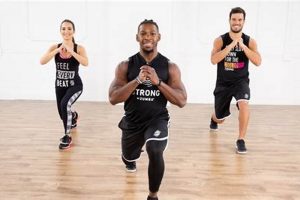
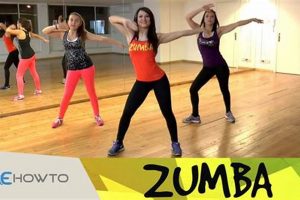
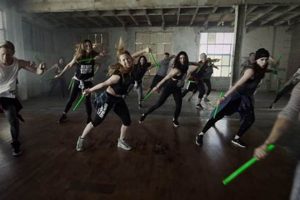
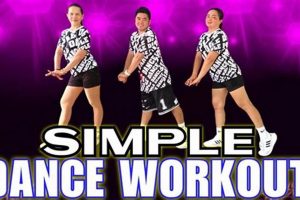
This high-intensity interval training (HIIT) program fuses fast-paced rhythmic dance movements with traditional strength training exercises. It incorporates bodyweight exercises, such as squats, lunges, and push-ups, synchronized to music. The routines are designed to maximize calorie burn and build muscular endurance.
This fitness approach is beneficial for enhancing cardiovascular health, improving muscle tone, and increasing overall body strength. It offers a dynamic alternative to conventional gym workouts, providing an engaging and motivating environment. The program’s origins lie in adapting elements of dance fitness to incorporate more structured strength-building exercises.
This article will further detail the specific exercises included, the typical class structure, and the potential fitness outcomes achievable through consistent participation. The variations available to accommodate different fitness levels and the nutritional considerations to optimize results will also be addressed.
Effective Strategies for Zumba Strong Workout Participation
The following guidelines are designed to enhance participation and optimize results for individuals engaging in the HIIT program incorporating dance elements and strength training.
Tip 1: Proper Form is Paramount: Prioritize correct technique over speed. Ensure squats are performed with a controlled descent, maintaining a straight back. Push-ups should engage the core and maintain a rigid plank position.
Tip 2: Hydration is Critical: Maintain adequate hydration before, during, and after each session. Dehydration can impede performance and increase the risk of muscle cramps.
Tip 3: Gradual Progression: Begin with modifications to exercises if needed. Gradually increase the intensity and duration of workouts as fitness levels improve.
Tip 4: Footwear Considerations: Wear supportive athletic shoes with good lateral support. This minimizes the risk of ankle injuries during the dynamic movements.
Tip 5: Listen to the Body’s Signals: Pay attention to pain or discomfort. Modify or discontinue exercises if sharp or persistent pain arises.
Tip 6: Pre-Workout Nutrition: Consume a balanced meal or snack containing carbohydrates and protein approximately 1-2 hours before each session. This provides sustained energy throughout the workout.
Tip 7: Post-Workout Recovery: Incorporate stretching and cool-down exercises after each session to improve flexibility and reduce muscle soreness.
Tip 8: Consistency is Key: Aim for at least three sessions per week to achieve noticeable improvements in strength, endurance, and overall fitness.
Adhering to these strategies can maximize the benefits of the program, contributing to enhanced physical performance and a reduced risk of injury.
The subsequent sections will explore advanced training techniques and strategies for maximizing the long-term benefits of this fitness regimen.
1. High-Intensity Intervals

High-intensity intervals (HIIT) are a core component of this fitness program, characterized by short bursts of intense exercise followed by brief recovery periods. In this context, these intervals manifest as segments of rapid-fire bodyweight exercises, such as squat jumps or high knees, performed in synchronization with the music. The purpose of these HIIT segments is to elevate the heart rate significantly, thereby maximizing caloric expenditure and enhancing cardiovascular fitness. For example, a routine might involve 30 seconds of burpees followed by 15 seconds of rest, repeated multiple times within a single track.
The integration of HIIT is integral to differentiating this workout from standard dance fitness programs. While the latter often emphasizes continuous movement at a moderate intensity, this fitness program alternates between dance-inspired sequences and periods of intense strength exercises. This alternation is crucial for triggering the “afterburn effect,” also known as excess post-exercise oxygen consumption (EPOC), where the body continues to burn calories at an elevated rate even after the workout is completed. This is a significant factor in promoting weight loss and improving metabolic function.
The understanding of the relationship between HIIT and this routine is practically significant for both instructors and participants. Instructors can leverage this knowledge to design routines that are both challenging and effective, while participants can adjust their effort levels during the HIIT segments to match their fitness goals. The cyclical nature of HIIT within this fitness format allows for the sustained physical exertion required to achieve tangible fitness results, distinguishing it as a targeted exercise modality.
2. Rhythmic Dance Movement

Rhythmic dance movement forms an integral component, dictating the tempo and transition between strength-based intervals. Its connection to the overall effectiveness lies in its ability to elevate heart rate and maintain engagement, thereby enhancing the duration and intensity of each session. The presence of structured dance patterns within the program contributes to the inherent enjoyability of the workout, influencing adherence and fostering long-term participation. For example, a merengue-inspired warm-up routine prepares muscles for the subsequent high-intensity exercises, diminishing the likelihood of injury during more demanding activities.
The specific choreography often leverages dynamic movements that recruit multiple muscle groups simultaneously. Consider a routine that alternates between salsa-inspired steps and plyometric exercises. The salsa portion increases the demand for core stabilization while engaging lower body musculature, while the plyometrics introduce elements of power and explosiveness, maximizing caloric expenditure and improving overall athleticism. The music’s tempo is calibrated to guide transitions between movements, ensuring that individuals maintain proper form during exercises, and reducing the chances of injury from overly rapid changes.
In summary, rhythmic dance movement functions not merely as a stylistic addition but as a strategic element. It sustains participant engagement, contributes to efficient warm-up and cool-down procedures, and facilitates smooth transitions between high-intensity intervals. Understanding this dynamic is essential for instructors aiming to design effective and enjoyable classes, as well as for participants seeking to maximize the benefits and minimize potential risks. The seamless integration of rhythmic dance with strength exercises strengthens the workout experience.
3. Strength Training Fusion

Strength training fusion constitutes a critical element in the design and execution of this distinct exercise modality. The integration of traditional strength exercises with dance-inspired movements elevates the effectiveness of the workout by simultaneously targeting multiple fitness components. This fusion creates a synergistic effect, where the benefits of both strength training and cardiovascular exercise are amplified, leading to improved overall physical conditioning. An example includes a sequence of squats seamlessly transitioning into a salsa step, engaging lower body muscles while simultaneously elevating heart rate and enhancing coordination.
The inclusion of strength training is not merely an add-on; it is fundamental to the structure and goals of the program. Without strength training components, the workout would primarily function as a cardio-focused dance class. However, the strategic integration of exercises such as push-ups, lunges, and planks transforms it into a comprehensive program that builds muscular endurance, enhances functional strength, and improves body composition. The choreography is carefully designed to ensure proper form and maximize muscle activation during strength segments. This can be seen in routines that incorporate isometric holds within dance sequences, challenging muscles for extended periods and promoting strength gains.
Understanding the link between strength training fusion and the workout is significant for both instructors and participants. Instructors can tailor their class routines to emphasize specific muscle groups or fitness goals, while participants can better understand the purpose and benefits of each exercise. The fusion aspect fosters a dynamic and engaging environment, mitigating the monotony often associated with conventional strength training. Moreover, this fusion allows individuals to build strength and endurance in a functional and accessible manner, supporting activities of daily living and promoting long-term fitness adherence. The blend ensures holistic fitness gains.
4. Bodyweight Exercise Focus

The emphasis on bodyweight exercises within the fitness program is a defining characteristic that contributes significantly to its accessibility and effectiveness. This focus aligns with the program’s overarching goal of delivering a comprehensive workout that enhances both cardiovascular health and muscular strength without requiring external equipment.
- Accessibility and Scalability
Bodyweight exercises eliminate the need for specialized equipment, allowing participants to engage in the program virtually anywhere. This accessibility promotes inclusivity and reduces barriers to entry for individuals with limited resources or access to traditional gym facilities. Furthermore, bodyweight exercises can be easily modified to accommodate varying fitness levels, ensuring that beginners can participate safely and effectively while more advanced individuals can be challenged through progressive variations.
- Functional Strength Development
Bodyweight exercises inherently engage multiple muscle groups simultaneously, promoting the development of functional strength that translates directly to real-world activities. Movements such as squats, lunges, and push-ups mimic natural human movements, improving balance, coordination, and overall physical functionality. This emphasis on functional strength enhances daily living activities and reduces the risk of injury.
- Core Engagement and Stability
Many bodyweight exercises require significant core engagement to maintain proper form and stability. Exercises like planks, mountain climbers, and variations of push-ups actively recruit core muscles, leading to improved posture, balance, and spinal stability. A strong core provides a solid foundation for all movements, enhancing athletic performance and reducing the likelihood of lower back pain.
- Proprioceptive Enhancement
Bodyweight exercises rely heavily on proprioception, the body’s awareness of its position in space. Performing exercises without external support challenges the neuromuscular system to maintain balance and control, leading to improved proprioceptive abilities. This enhanced body awareness contributes to better coordination, agility, and injury prevention, particularly in dynamic activities.
The bodyweight exercise focus underscores the fitness program’s commitment to delivering a comprehensive and accessible fitness solution. By leveraging the inherent benefits of bodyweight training, the program effectively promotes strength, endurance, stability, and functional movement patterns, making it a versatile and effective choice for individuals seeking a holistic fitness experience.
5. Core Engagement Priority

In the context of this fitness program, the principle of prioritizing core engagement is not an ancillary consideration, but a foundational requirement for both maximizing efficacy and minimizing injury risk. The dynamic and high-intensity nature of the program necessitates a stable and responsive core musculature.
- Spinal Stabilization
The core muscles encompassing the rectus abdominis, obliques, transverse abdominis, and erector spinae function to stabilize the spine during movement. In this fitness program, the rapid transitions and plyometric exercises place significant demands on spinal stability. Insufficient core engagement can lead to compensatory movements, increasing the risk of lower back pain or injury. Activating the core musculature prior to and during each exercise ensures that the spine remains aligned, distributing force effectively and protecting against potential harm.
- Power Transfer Enhancement
The core serves as a conduit for power transfer between the upper and lower body. In many of the program’s movements, force generated in the legs is transmitted through the core to the arms and torso. Adequate core engagement allows for efficient and effective power transfer, optimizing the execution of exercises and maximizing calorie expenditure. Weak core muscles can result in energy leakage and reduced power output, diminishing the overall effectiveness of the workout.
- Postural Alignment Maintenance
Maintaining proper postural alignment is critical for both injury prevention and optimal performance. The core muscles play a vital role in maintaining an upright posture and preventing excessive spinal flexion or extension during dynamic movements. Insufficient core engagement can lead to postural deviations, increasing stress on joints and muscles. Actively engaging the core helps to maintain a neutral spine, promoting efficient movement patterns and reducing the risk of musculoskeletal imbalances.
- Respiratory Efficiency Optimization
The core muscles, particularly the transverse abdominis, play a supporting role in respiration. During high-intensity exercise, efficient breathing is essential for maintaining oxygen supply to working muscles. Engaging the core can improve respiratory efficiency by stabilizing the diaphragm and facilitating deeper, more effective breaths. Proper breathing techniques, coupled with core engagement, help to prevent fatigue and optimize performance throughout the program.
Therefore, core engagement priority is not merely a suggestion, but an integral component of safe and effective participation in this fitness program. Participants are strongly encouraged to focus on consciously activating their core musculature throughout each session, prioritizing form over speed or intensity when necessary. This emphasis on core engagement will contribute to enhanced spinal stability, improved power transfer, better postural alignment, and optimized respiratory efficiency, ultimately maximizing the benefits and minimizing the risks associated with this rigorous training modality.
6. Progressive Overload Implementation

Progressive overload implementation, within the context of this fitness methodology, represents a systematic increase in the demands placed upon the musculoskeletal system over time. This principle is not simply an optional strategy but an essential requirement for achieving sustained improvements in strength, endurance, and overall physical capacity. Without deliberate application of progressive overload, the body adapts to the initial training stimulus, resulting in a plateau in fitness gains. The link between progressive overload and this workouts efficacy is causal: consistent application of increased stress leads to adaptations, whereas the absence of such stress restricts continued advancement.
The practical application of progressive overload within this framework takes several forms. Firstly, the intensity of bodyweight exercises can be gradually increased. For instance, standard squats can progress to jump squats or pistol squats. Secondly, the duration of high-intensity intervals can be extended, or the rest periods can be shortened. Thirdly, the complexity of dance movements can be elevated, requiring greater coordination and muscle activation. Real-life examples of this implementation involve individuals initially performing modified push-ups on their knees and subsequently progressing to full push-ups, or those increasing the number of repetitions performed within a set time interval. Such structured progression ensures a continuous challenge to the body, preventing stagnation and fostering ongoing improvement.
Understanding the significance of progressive overload implementation is practically valuable for both instructors and participants. Instructors can strategically design class routines that gradually increase in difficulty, ensuring that participants are consistently challenged. Participants, in turn, can actively monitor their progress and make informed adjustments to their training intensity and volume. However, challenges exist. Implementing overload too rapidly can increase the risk of injury, while failing to implement it at all results in diminished returns. Therefore, a balanced and measured approach, guided by individual capabilities and fitness goals, is paramount. This understanding contributes to sustained progress and long-term adherence to the fitness program.
Frequently Asked Questions About Zumba Strong Workout
The following section addresses common inquiries regarding this high-intensity interval training program, providing clarity on its mechanics, benefits, and suitability for various fitness levels.
Question 1: Is this program suitable for individuals with no prior fitness experience?
The program incorporates modifications for exercises, enabling individuals of varying fitness levels to participate. Beginners should focus on mastering proper form and gradually increasing intensity as their strength and endurance improve.
Question 2: How does this routine differ from traditional Zumba classes?
While both incorporate music and movement, Zumba focuses on dance fitness, whereas this alternative combines dance-inspired sequences with structured strength training exercises, emphasizing high-intensity intervals.
Question 3: What type of footwear is recommended for this program?
Supportive athletic shoes with good lateral stability are recommended to minimize the risk of ankle injuries during the dynamic movements.
Question 4: How frequently should one participate in this program to see noticeable results?
Consistent participation of at least three sessions per week is generally required to achieve noticeable improvements in strength, endurance, and overall fitness.
Question 5: Are there any specific nutritional recommendations to optimize results from this workout?
A balanced diet with adequate protein intake supports muscle recovery and growth. Hydration before, during, and after each session is also critical.
Question 6: What are the potential risks associated with this high-intensity workout?
Improper form, inadequate hydration, or overexertion can lead to injuries. It is crucial to listen to the body, modify exercises as needed, and consult with a healthcare professional if any concerns arise.
This FAQ has provided a foundational understanding of the HIIT-dance program. Prioritizing proper form and gradually increasing intensity and volume. The next article will explore detailed nutritional considerations.
The subsequent section will explore advanced training techniques and strategies for maximizing the long-term benefits of this fitness regimen.
Conclusion
The preceding analysis has provided a comprehensive examination of the high-intensity interval training program integrating dance elements and strength training. Key components, including the importance of bodyweight exercises, core engagement, and progressive overload, have been explored. These elements, when implemented with proper form and adherence to safety guidelines, contribute to enhanced cardiovascular fitness, muscular endurance, and overall functional strength.
The consistent application of the principles outlined herein holds the potential for substantial improvements in physical well-being. Continued research and refinement of training protocols may further optimize the benefits of this fitness modality. A commitment to understanding and implementing these principles remains critical for both practitioners and instructors seeking to maximize its effectiveness and minimize potential risks.