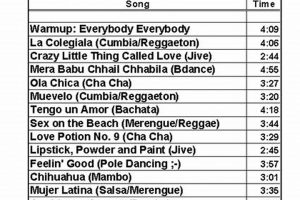
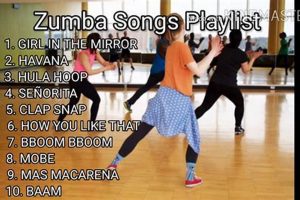
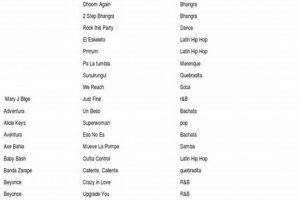
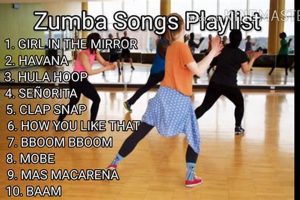
The ability to maintain pace and coordination with music specifically designed for Zumba fitness routines requires a combination of physical fitness, rhythmic awareness, and familiarity with the choreography. This involves synchronizing movements with the tempo and style of the music, as well as executing the steps accurately and continuously throughout the duration of the song. An example would be successfully performing a complex salsa sequence during a fast-paced track in a Zumba class.
Successfully following the musical and choreographic demands of such routines is vital for maximizing the cardiovascular benefits, improving coordination, and enhancing the overall enjoyment of the Zumba experience. The selection and structure of musical pieces have evolved over time, incorporating diverse genres and rhythms to provide a dynamic and engaging workout. Its historical roots in Latin dance and fitness trends contribute to its contemporary appeal.
The following sections will delve into the specific elements of musicality, choreography, and physical conditioning that contribute to the skill of maintaining pace, and how individuals can improve their capacity to keep up during a Zumba workout.
Tips for Maintaining Pace During a Zumba Routine
The following recommendations aim to improve an individual’s ability to maintain pace and coordination during a Zumba fitness class. These strategies focus on enhancing physical conditioning, rhythmic awareness, and familiarity with common dance steps.
Tip 1: Build a Foundation of Cardiovascular Fitness: Regular aerobic exercise, such as running, swimming, or cycling, improves overall cardiovascular health. This foundation allows the body to sustain elevated heart rates for extended periods, reducing fatigue during a Zumba class. For instance, incorporating 30 minutes of jogging three times a week can significantly improve endurance.
Tip 2: Enhance Rhythmic Awareness Through Music: Active listening and rhythmic practice outside of class can improve an individual’s ability to synchronize movements with music. Try clapping or tapping along to Zumba music selections to internalize the beat and anticipate changes in tempo. Consistently practicing will lead to improved timing and coordination.
Tip 3: Familiarize Yourself with Common Zumba Steps: Practice basic Zumba steps, such as the Salsa, Merengue, Cumbia, and Reggaeton, outside of class. Utilize online resources, such as instructional videos, to learn the correct technique and footwork. Repeated practice builds muscle memory, allowing for more fluid execution during a class.
Tip 4: Attend Zumba Classes Regularly: Consistent participation in Zumba classes fosters familiarity with the instructor’s choreography and teaching style. Regular attendance also provides opportunities to practice and refine technique in a supportive environment. Aim for at least two to three classes per week for optimal results.
Tip 5: Modify Movements to Suit Individual Fitness Levels: Adapt high-impact movements, such as jumps and leaps, to lower-impact variations as needed. Reduce the range of motion or slow down the pace to maintain control and avoid injury. Listening to the body’s signals and making appropriate modifications ensures a sustainable and enjoyable workout.
Tip 6: Focus on Proper Form and Technique: Maintaining correct posture and alignment during Zumba movements is crucial for preventing injuries and maximizing effectiveness. Engage core muscles and maintain a stable base of support throughout each step. Seek guidance from the instructor on proper form as needed.
Tip 7: Hydrate Adequately Before, During, and After Class: Dehydration can lead to fatigue and muscle cramps, hindering performance. Drink plenty of water throughout the day and bring a water bottle to class. Replenish fluids after the workout to aid in recovery.
By implementing these strategies, individuals can enhance their capacity to keep pace during a Zumba routine, leading to improved fitness outcomes and a more rewarding exercise experience. The key is consistent effort and mindful attention to individual capabilities and limitations.
The next section will explore common challenges encountered during Zumba classes and strategies for overcoming them.
1. Tempo Consistency

Tempo consistency, the ability to maintain a consistent pace in synchrony with a musical beat, is fundamental to successfully completing a Zumba routine. It directly influences an individual’s capacity to execute movements accurately and consistently throughout the duration of each song.
- Beat Matching
Beat matching refers to the synchronization of movements to the underlying pulse of the music. In Zumba, movements are often designed to align with specific counts within a musical measure. For example, a grapevine step might span four beats, requiring the participant to execute each movement precisely on the designated count. Deviations from the beat disrupt the flow of the choreography and can lead to incoordination.
- Rhythmic Accuracy
Rhythmic accuracy encompasses the precision with which movements are performed in relation to the music’s rhythm. This includes maintaining the correct timing for steps, turns, and arm movements. Inaccurate timing can result in a loss of synchronization and reduced effectiveness of the workout. For instance, failing to complete a jump on the designated beat can diminish the impact of the exercise and increase the risk of injury.
- Maintaining Cadence
Maintaining cadence involves sustaining a consistent rate of movement that corresponds to the tempo of the music. Faster tempos require a higher cadence, while slower tempos necessitate a more deliberate pace. The ability to adjust and maintain cadence is crucial for adapting to the varying tempos present in Zumba routines. If an individual struggles to maintain the required cadence, they may fall behind or become fatigued more quickly.
- Anticipating Tempo Changes
Many Zumba songs incorporate tempo changes to add variety and challenge. The ability to anticipate and adapt to these changes is essential for maintaining tempo consistency. This requires a heightened awareness of the music’s structure and an ability to predict upcoming variations in tempo. Successfully anticipating tempo changes allows the participant to seamlessly transition between movements and maintain the overall flow of the routine.
The facets of beat matching, rhythmic accuracy, cadence maintenance, and tempo change anticipation are integral to successfully performing Zumba routines. These elements directly influence an individual’s ability to “keep up,” ensuring that movements are synchronized with the music. The development of these skills enhances the overall effectiveness and enjoyment of the Zumba experience.
2. Choreography Memorization

Choreography memorization constitutes a critical determinant in an individual’s capacity to successfully engage with a Zumba routine. The ability to recall and execute the sequence of steps directly affects the capacity to maintain pace with the music. A lack of choreographic familiarity necessitates increased cognitive processing to determine the next movement, resulting in a delay in physical execution. This lag creates a disconnect between the participant’s actions and the music, preventing them from fully “keeping up” with the intended rhythm and flow. An example is seen when a participant hesitates or performs a step incorrectly, breaking the flow and potentially causing them to fall behind during a fast-paced section of a routine.
The influence of choreography memorization extends beyond mere step recall. With improved memorization, individuals can anticipate upcoming movements, allowing for smoother transitions and a greater focus on proper form and engagement with the music. This leads to an enhanced overall workout experience and a reduction in the cognitive load required to participate. For instance, if a routine features a repeated sequence of salsa steps followed by a merengue segment, memorizing this pattern allows the participant to anticipate the merengue and transition smoothly, rather than reacting to each step in real-time. Furthermore, it allows individuals to add their own stylistic interpretation to the routine, fostering greater expression and engagement with the dance.
In summary, effective choreography memorization is not merely about knowing the steps, but about internalizing the routine to a level where movement becomes fluid and responsive to the music. Challenges related to memorization often arise from complex choreography or a lack of consistent practice. Overcoming these hurdles necessitates dedicated rehearsal and a focus on understanding the structure and patterns within the routines. By mastering choreography memorization, individuals significantly increase their ability to maintain pace and fully immerse themselves in the Zumba experience.
3. Rhythmic Entrainment

Rhythmic entrainment, the synchronization of an individual’s internal rhythms with an external rhythm, serves as a foundational element for successfully engaging with music-driven exercise programs. In the context of Zumba fitness routines, the ability to entrain to the music directly dictates an individual’s capacity to coordinate movements and maintain pace with the choreography. A failure to entrain results in a desynchronization between the individual’s movements and the beat, making it exceedingly difficult to “keep up”. For example, if the music features a strong four-beat pulse, an individual must internally align their steps and movements with that pulse to maintain cohesion with the class and the routine.
The effectiveness of rhythmic entrainment in Zumba is influenced by factors such as musical aptitude, experience with similar rhythmic patterns (e.g., prior dance training), and attentional focus. Individuals with a higher degree of musical aptitude typically demonstrate an enhanced capacity for entrainment, allowing them to more easily synchronize their movements with the music. Consistent exposure to the rhythmic structure prevalent in Zumba (e.g., salsa, merengue, cumbia) also fosters entrainment. The development of this skill extends beyond mere physical coordination; it can also lead to enhanced motor learning and cognitive processing speed. For example, individuals can learn to predict rhythmic changes and modify their movements in anticipation of the tempo changes.
The capacity for rhythmic entrainment is critical in allowing an individual to keep up with Zumba song. An understanding of rhythmic entrainment provides insight into optimizing training methods and enhancing the overall effectiveness of these exercise programs. By cultivating rhythmic skills and actively engaging with the music, individuals can significantly improve their ability to maintain pace and enjoy the comprehensive benefits of Zumba.
4. Endurance Capacity

Endurance capacity, the ability to sustain physical exertion over a prolonged period, constitutes a critical factor in determining an individual’s ability to maintain pace and effectively participate in Zumba fitness routines. These routines, characterized by continuous movement and varying intensity levels, demand a substantial degree of stamina to prevent fatigue and maintain synchronization with the music. A limited endurance capacity directly impedes the ability to keep up.
- Cardiovascular Efficiency
Cardiovascular efficiency, the effectiveness with which the heart and circulatory system deliver oxygen to working muscles, is paramount for sustained physical activity. High cardiovascular efficiency allows the body to maintain an elevated heart rate and oxygen uptake for extended durations without undue strain. In Zumba, this translates to the ability to execute high-energy movements while maintaining breath control and minimizing fatigue. Individuals with poor cardiovascular efficiency will experience a more rapid onset of fatigue, impacting their ability to sustain the routine and “keep up” with the music. An example would be someone who becomes winded early in the class compared to someone who can continue without undue stress.
- Muscular Endurance
Muscular endurance, the capacity of muscles to perform repeated contractions over an extended period, plays a crucial role in executing the repetitive movements characteristic of Zumba. Strong muscular endurance enables the legs, arms, and core to perform the dance steps without premature fatigue or muscle strain. Insufficient muscular endurance results in a decline in form, reduced movement quality, and ultimately, an inability to maintain pace with the music. An example is an individual whose legs or arms start to feel heavy near the end of the Zumba class preventing them from continuing.
- Anaerobic Threshold
Anaerobic threshold refers to the point during exercise at which the body begins to rely more heavily on anaerobic metabolism, leading to the accumulation of lactate and subsequent fatigue. A higher anaerobic threshold allows an individual to perform at a higher intensity for a longer period before experiencing significant fatigue. In Zumba, maintaining an intensity level below the anaerobic threshold is essential for sustaining performance throughout the entire class. Those exceeding their anaerobic threshold will experience a rapid buildup of fatigue, impacting their ability to synchronize movements with the music and “keep up” effectively. Individuals who exercise regularly will have a higher threshold than people who do not.
- Recovery Rate
Recovery rate, the speed at which the body returns to a resting state following physical exertion, significantly impacts the ability to participate fully in a Zumba class. A faster recovery rate allows the individual to quickly recover from high-intensity bursts and maintain a relatively consistent level of performance throughout the session. A slower recovery rate results in accumulated fatigue, making it increasingly challenging to keep pace with the music and perform movements correctly. For instance, someone who is able to resume a movement after a short rest will have a faster recovery rate than someone who needs a longer rest.
These facetscardiovascular efficiency, muscular endurance, anaerobic threshold, and recovery ratecollectively determine an individual’s endurance capacity and their ability to “keep up” with the demands of a Zumba routine. Developing these aspects through targeted training regimens will enhance performance and maximize the benefits derived from participation in Zumba fitness classes. It is important to remember the value of starting slowly and gradually increasing the duration and intensity of activity for the best possible results.
5. Musicality Integration
Musicality integration, the capacity to expressively translate the nuances of music into physical movements, constitutes a crucial element in effectively engaging with Zumba fitness routines. The ability to embody the emotion, rhythm, and stylistic characteristics of the music directly affects the quality of movement and the overall engagement with the exercise. Within Zumba, musicality integration enables individuals to move beyond simply executing steps, allowing them to inhabit the music and create a more dynamic and expressive performance. This is vital to keep up with Zumba songs.
The lack of musicality integration results in a disconnect between movement and the underlying musicality. This disconnect diminishes the effectiveness of the exercise. This may manifest as a mechanical performance of steps lacking expression, improper body language that does not suit the tempo, and a general failure to embody the spirit of the music. In contrast, individuals with well-developed musicality integration can channel the energy and emotion of the music, resulting in more fluid, engaging, and aesthetically pleasing movements. For example, someone might exaggerate their hip movements during a salsa song or add more bounce during a reggaeton song.
Successfully integrating musicality allows individuals to maximize the benefits of the Zumba experience. Improved engagement with the music enhances motivation, reduces perceived exertion, and fosters a greater sense of enjoyment. Musicality integration serves as a key to unlocking the transformative power of Zumba, enabling participants to move beyond mere physical exercise to experience a form of artistic expression and personal empowerment. By prioritizing the connection between music and movement, the participant can fully embrace the Zumba experience and more successfully keep up. Musicality Integration is essential for fitness success with Zumba.
Frequently Asked Questions
The following questions address common inquiries regarding the ability to maintain pace and coordination with music in Zumba fitness routines. These responses aim to provide clear and informative answers based on established exercise principles.
Question 1: What factors contribute to the difficulty in maintaining pace with the music in a Zumba class?
Several factors influence an individual’s capacity to keep up with the musical demands of a Zumba class. These include, but are not limited to, cardiovascular fitness, rhythmic awareness, familiarity with common dance steps, choreography memorization, and musicality integration. The interplay of these elements determines the ease or difficulty experienced during a routine.
Question 2: How can cardiovascular fitness be improved to enhance the ability to keep up with Zumba routines?
Regular participation in aerobic exercises, such as running, swimming, or cycling, improves overall cardiovascular health. Aim for a minimum of 150 minutes of moderate-intensity or 75 minutes of vigorous-intensity aerobic activity per week, as recommended by established health guidelines. This foundation allows the body to sustain elevated heart rates for extended periods during a Zumba class.
Question 3: What techniques can be employed to enhance rhythmic awareness and coordination?
Active listening to Zumba music selections and practicing rhythmic patterns outside of class can improve rhythmic awareness. Try clapping or tapping along to the music to internalize the beat. Utilizing online resources or attending dance classes focused on rhythm and timing can further enhance coordination skills.
Question 4: How important is memorization of Zumba choreography for maintaining pace?
Memorization of common Zumba steps and routines significantly improves the ability to maintain pace. Familiarity with the choreography reduces cognitive load, allowing for smoother transitions and a greater focus on executing movements with proper form. Practice basic Zumba steps outside of class using instructional videos or online tutorials to build muscle memory.
Question 5: Is it acceptable to modify Zumba movements to accommodate individual fitness levels?
Modifying Zumba movements to suit individual fitness levels is not only acceptable but also recommended. Adapting high-impact movements to lower-impact variations, reducing the range of motion, or slowing down the pace allows individuals to participate safely and effectively while minimizing the risk of injury. Listening to the body’s signals is crucial for ensuring a sustainable and enjoyable workout experience.
Question 6: How does musicality integration enhance the Zumba experience, and does it impact the ability to keep up?
Musicality integration, or the expression of music through movement, enhances the overall Zumba experience by fostering a deeper connection with the music and the routine. While not directly impacting physical pace, the enhanced engagement and enjoyment can improve motivation and reduce perceived exertion, indirectly contributing to an increased ability to keep up with the music.
Successfully participating in Zumba requires a multifaceted approach that considers physical fitness, rhythmic acuity, and choreographic understanding. By addressing these elements, individuals can enhance their capacity to keep pace with the music and reap the benefits of this dynamic exercise program.
The next section will focus on overcoming common plateaus and maintaining motivation in Zumba.
Conclusion
The examination of the phrase “can you keep up zumba song” reveals a complex interplay of physical, cognitive, and musical factors that determine an individual’s successful engagement with Zumba fitness routines. Cardiovascular endurance, rhythmic awareness, choreography memorization, and musicality integration each contribute to the ability to synchronize movements effectively and maintain pace with the music. A comprehensive understanding of these elements facilitates informed training approaches and maximizes the benefits derived from Zumba participation.
While the pursuit of seamless synchronization with Zumba music presents a challenge, continuous effort and strategic development of these core competencies represent a pathway to enhanced fitness outcomes and a more profound appreciation for the art of movement. Further research into the neurological and physiological underpinnings of rhythmic entrainment within exercise contexts may unlock even more effective training methodologies for maximizing performance and overall well-being.